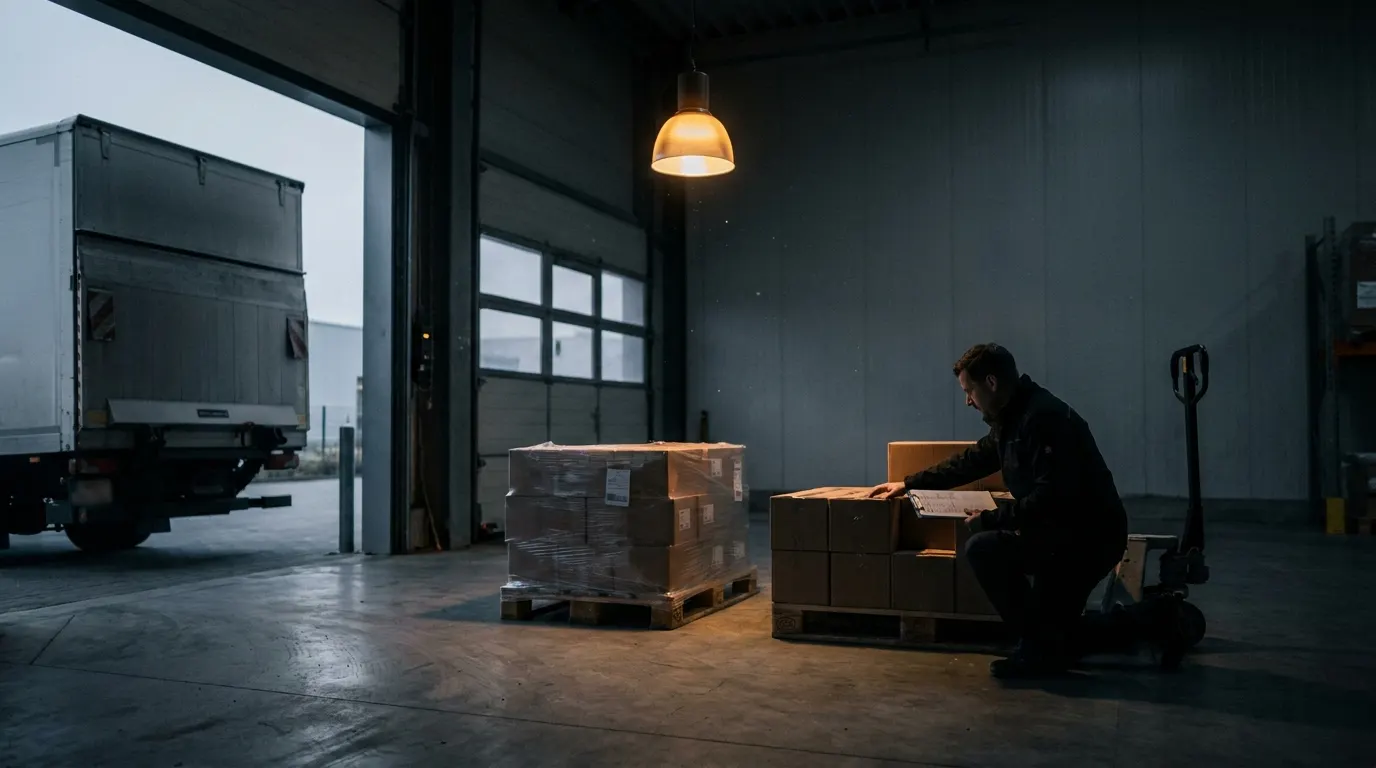
Goods receipt inspection checklist: what to check at the dock, and who checks it

T. Krause
Why the check at the dock pays off later
An error that slips through goods receipt almost never shows up there. Assembly finds it when a box holds fewer parts than the system says and the order stops halfway through the batch. The warehouse finds it months later as a count difference that nobody can trace back. How those differences build up is covered in our article on why stock records drift away from the shelf. A delivery booked at the delivery-note quantity instead of the counted quantity produces exactly that kind of gap.
Purchasing finds it last. They want to raise a complaint with the supplier, and the supplier asks why the defect is only being reported now. If the goods sat on a shelf for two weeks without a check, you are in a weak position commercially, and sometimes legally as well.
A receiving inspection won't catch every error. It moves the moment of discovery to where fixing it costs least. That place is the dock, while the driver is still in the yard and the new parts haven't been mixed in with existing stock.
Most plants already have a checklist. Often it hangs laminated next to the dock door and nobody remembers who wrote it. The list below is built so that every item settles two questions. What do you compare against, and who does the check? If either answer is missing, the item gets skipped on a busy day.
Why goods can sit in the building for days without existing for planning is the subject of a separate piece on the gap between unloading and booking. This one is about the inspection itself.
The checklist in five stages
The stages follow the material from the purchase order to release. Adjust the owners to your plant. In a company of 30 people, receiving and quality are often the same person. What matters is that every check has a named owner.
Stage 1: Before the truck arrives
| Check | Compare against | Owner |
|---|---|---|
| Today's expected deliveries are known | Open purchase orders, advance shipping notices, order confirmations | Purchasing or planning, first thing in the morning |
| Urgent lines are flagged | Production orders waiting for the material | Planning |
| Inspection requirements are set per item | Inspection plan or item master (scope, certificate required) | Quality |
| Space is free, including the quarantine area | Warehouse occupancy | Warehouse lead |
This stage takes a few minutes each morning. Without it, the search for the purchase order starts at the dock while the driver waits.
Inspection requirements belong in the item master, not in the head of the one experienced colleague who happens to be on holiday. When scope or certificate requirements are missing or out of date there, everyone inspects by their own judgement. Our piece on master data errors that look like system problems explains why this is so often where the real fix lies.
Stage 2: At the dock
| Check | Compare against | Owner |
|---|---|---|
| Supplier and consignee are correct | Purchase order, shipping notice | Receiving |
| Delivery note matches the order (order number, item, quantity) | Purchase order in the ERP | Receiving |
| Number of packages and pallets | Delivery note, consignment note | Receiving, with the driver present |
| Visible damage to packaging and pallets | Visual check, photos | Receiving, with the driver present |
| Labels show item number, batch or serial number | Delivery note, purchase order | Receiving |
| Quantity per line | Delivery note, counting scale for small parts | Receiving |
| Delivery date kept | Confirmed date from the order confirmation | Receiving, logged for supplier rating |
Check the package count and outer damage while the driver is still there. Damage the driver has signed for on the consignment note is easier to argue with the carrier and the supplier than damage someone finds while unpacking the next day. Take photos before the stretch wrap comes off.
Quantity is where most corners get cut. People count when there's time, and otherwise the delivery note wins. So decide which items always get counted. Good candidates are expensive parts, parts with tight stock and parts where this supplier has been short before. For everything else, a sample count is enough as long as it's recorded.
Stage 3: Quality inspection
| Check | Compare against | Owner |
|---|---|---|
| Inspection scope decided (full check, sample, or none) | Inspection plan, supplier rating | Quality |
| Sample drawn and recorded | Sampling plan | Receiving or quality |
| Required certificates are present | Purchase order, quality agreement | Quality |
| Values on the certificate meet the specification | Drawing, material specification | Quality |
| Characteristics measured | Inspection plan, drawing, calibrated gauges | Quality |
| Shelf life and storage conditions, e.g. for adhesives and paints | Data sheet, safety data sheet | Quality or warehouse |
Not every delivery needs a full inspection. The scope depends on how critical the part is and on the supplier's track record. Standard fasteners from a distributor you've had no trouble with for years need a different check than a casting from a new supplier. Standardised sampling schemes exist for this, such as ISO 2859-1, where the sample size follows from the lot size and the acceptance quality limit (AQL) you agree with the supplier.
With certificates you check two things. Is it there, and do the values match what you ordered? If your order asks for an inspection document to EN 10204, say a 3.1 inspection certificate, a 2.2 test report doesn't meet it. A certificate filed without anyone reading it only proves that paper arrived.
Stage 4: Booking into the system
| Check | Compare against | Owner |
|---|---|---|
| Receipt booked on the day of delivery | Delivery note, counted quantity | Receiving |
| Booked quantity is the counted one, not the delivery-note figure | Count result | Receiving |
| Stock status is right (blocked, in inspection, released) | Result of the quality check | Quality releases, receiving books |
| System bin location matches the physical location | Where the goods actually are | Warehouse |
| Batch or serial number captured | Label, certificate | Receiving |
| Delivery note and inspection records attached to the transaction | Purchase order in the ERP | Receiving |
Booking is what makes the goods visible to planning. So book them straight away as blocked stock and release them after inspection. Planning can then see the material is in the building, and nobody pulls it into production before it's cleared.
The other common mistake is booking the delivery-note quantity because it's quicker. The system then holds whatever the supplier claimed, and the difference only turns up at the next count.
Stage 5: Deviations
| Check | Compare against | Owner |
|---|---|---|
| Nonconforming goods separated and labelled | Quarantine area, block label | Receiving |
| Goods blocked in the system | Stock status | Receiving or quality |
| Deviation documented | Purchase order, delivery note, inspection record, photos | Receiving or quality |
| Purchasing and planning informed | Production orders waiting for the goods | Quality |
| Notice of defect sent to the supplier | Supply contract, quality agreement | Purchasing or quality |
| Decision made on return, rework or concession | Agreement with the supplier, production demand | Quality with purchasing |
What matters when something is wrong
With a deviation, order matters. First separate and block the goods so nobody takes them into production by mistake. Then document while everything is still at the dock. The question of whose fault it was comes after that.
The record needs less than people expect. What was ordered, what arrived, what the deviation is, who found it and when, plus photos and the delivery note. With that, purchasing can raise the complaint without walking back to the warehouse.
If you buy from German suppliers, the law adds a duty between merchants. Under section 377 of the German Commercial Code (HGB), when a sale is a commercial transaction for both parties, the buyer has to inspect the goods without undue delay after delivery, as far as that is feasible in the ordinary course of business, and notify the seller of any defect without undue delay. If the buyer fails to give notice, the goods are deemed approved under section 377(2), and the buyer generally loses its claims for that defect. The exception is a defect that was not recognisable on inspection. A defect that couldn't be found on inspection has to be reported without undue delay once it's discovered. Supply contracts and quality agreements often set out scope and deadlines in more detail. This is not legal advice. If in doubt, have your rules checked by someone who knows your contracts.
If your plant is certified to ISO 9001, you already have to show that you control purchased products and evaluate suppliers. The deviations recorded at goods receipt are a better basis for that than gut feeling in the annual supplier meeting.
Keeping the checklist from turning into paperwork
A paper checklist works on day one. The weakness shows after a few weeks. Completed sheets go into a binder, and the results get typed into the ERP or never do. Ask how often a particular supplier delivered the wrong quantity, and someone has to leaf through the binder to answer.
In the plants I know, the media breaks in receiving sit in similar places:
- The delivery note arrives on paper while the order lives in the ERP. The comparison happens with a finger on the sheet.
- The counted quantity goes on a scrap of paper and gets booked later, often by someone else.
- Photos of transport damage sit on somebody's personal phone.
- The certificate arrives by email in purchasing, while the inspection happens in the warehouse.
- The complaint starts life as a separate document with no link to the receiving record.
What that retyping and searching costs day to day is the topic of our piece on what retyping documents into the ERP really costs.
Don't digitise everything at once. Start with booking. Receiving books on the day of delivery, with the counted quantity and blocked status, right at the goods, for example with a scanner or tablet at the dock. That immediately changes the stock figure planning works from. Second, capture deviations with a photo attached to the transaction. Your supplier rating then builds itself without anyone keeping a separate list. The quality department's inspection records come last. They take the most effort to switch over and change the least about daily work.
And keep the list short. Every item that nobody actually checks devalues the others, because ticking boxes becomes a formality. Better to delete an item than let people tick it without looking.
When receiving still jams despite the checklist
A checklist puts the checks in order. It doesn't show where time gets lost in the flow, or why bookings keep landing the day after delivery. If your goods receipt is stuck in several places at once, look at the whole flow from purchase order to release. A process analysis does that. We measure the process with real timestamps from your plant and hand you a prioritised list of what to change first.