Media Breaks: What Retyping That PDF Really Costs

T. Krause
The symptom
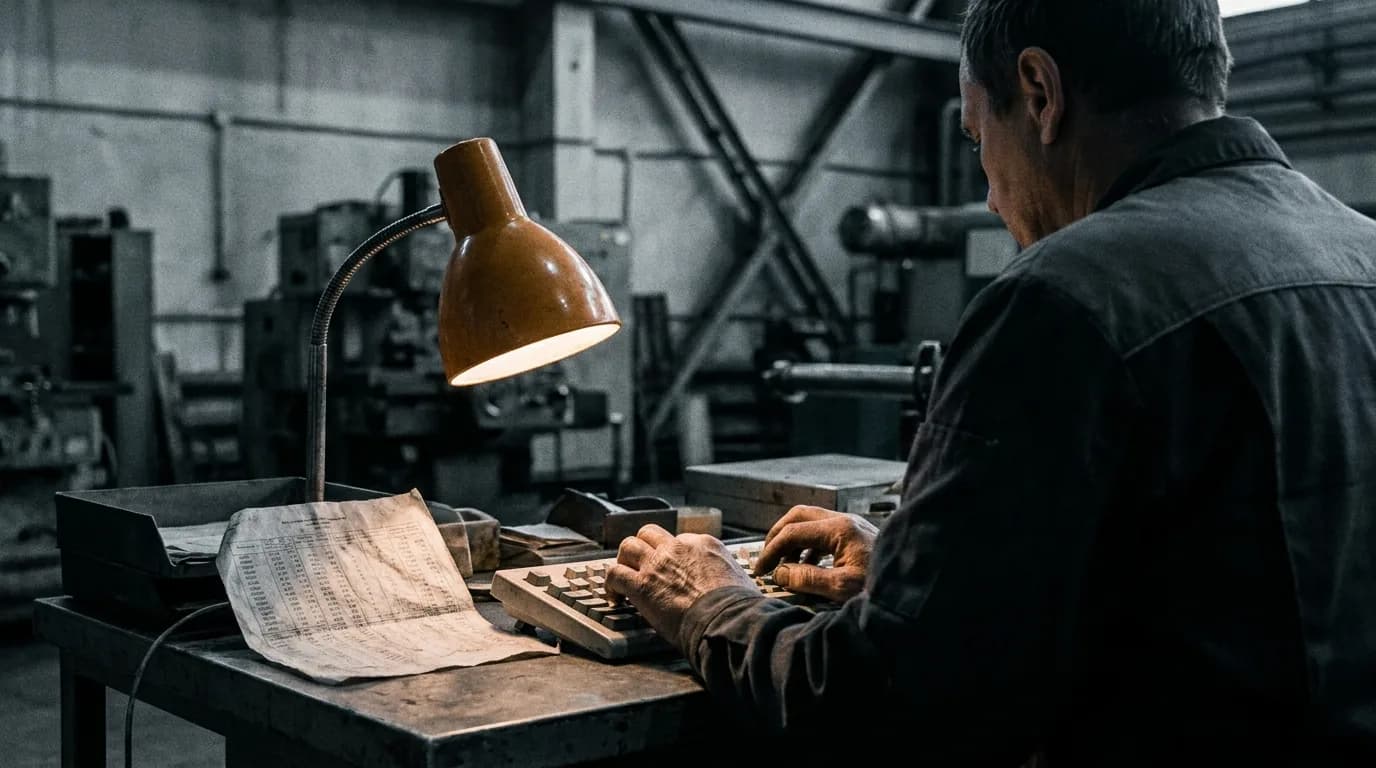
Every business has them and nobody calls them that: the points where information falls out of one system and gets typed back into another. The order arrives as a PDF attachment and is transferred into the ERP. The supplier invoice is printed, signed off, retyped. Timesheets come off the shop floor on paper and are entered into payroll. The delivery note is photographed and the quantity booked by hand.
Ask why it works that way and you nearly always get the same answer: "It's only a few minutes." True. Which is exactly why nobody has ever costed it.
The mechanism
A media break costs on three levels, and only the first is obvious.
Time. Four minutes per transaction, at 60 transactions a day, is four hours. Half a position, spread across several people so that it appears in no capacity calculation. It only becomes visible when someone is off sick.
Error rate. Manual transfer of numerical data produces errors in the order of half a per cent to one per cent of fields — independent of care and experience. At 60 transactions with eight relevant fields each, that's two to five errors a day on the arithmetic. Most get caught. The ones that don't are the expensive ones.
Delay. This is the item nobody has on the invoice. Retyping doesn't happen immediately, it happens in batches — evenings, mornings, Fridays. Between the arrival of the information and its availability in the system lie hours or days. During that window, somebody else makes a decision without it.
The three levels reinforce each other. People retyping under time pressure make more errors. Correcting errors takes more time. And because both are unpleasant, work gets batched rather than done immediately — which increases the delay.
A side effect I see regularly: media breaks breed secondary systems. Since the transfer is manual anyway, "while we're at it" a spreadsheet gets maintained alongside, holding extra information for which the ERP has no field. That spreadsheet becomes the real working basis — and the media break has produced a shadow ERP.
The cost
An anonymised example, altered in detail, real in pattern. A wholesaler of industrial supplies received a substantial share of customer orders as PDFs or scanned faxes. Two internal sales staff transferred those orders into the ERP, averaging 85 line items a day.
We measured over six weeks. Pure data entry time came to around 3.2 hours daily. The rest was more interesting: on 0.9 per cent of entered lines, at least one field deviated from the source — mostly quantity or article number. That's roughly 190 incorrect lines per quarter.
The downstream cost of those 190 lines was reconstructable: 61 led to incorrect deliveries with collection and reshipment, averaging €84 per case. 44 were caught before dispatch and corrected internally, at a cost but without external visibility. The remainder split between price differences and credit notes. In total, around €21,000 a year in direct cost — plus two customer complaints that led into framework contract renegotiations.
Data entry time itself, valued at labour cost, ran to about €29,000 annually. So the error share cost nearly as much as the work.
The fix
The obvious solution — asking customers to order electronically — worked only with the largest. For the rest, the break wasn't eliminated but bridged.
Incoming order PDFs are read automatically and presented in the ERP as a proposal. The employee no longer types; she checks and confirms. That sounds like a small difference and is a large one: checking is faster than entering, and the error type changes — instead of typos you get recognition errors, and those are conspicuous rather than plausible.
Two plausibility rules were added: quantity outside the historical range for that customer and article, and article numbers with no ordering history for that customer. Either triggers a query before release.
Entry time fell to around 50 minutes daily. The error rate on entered lines dropped below 0.2 per cent. The freed capacity didn't go into headcount reduction but into active customer contact — which in this case became the genuinely interesting number.
The point is the sequence: find and measure the break first, then decide whether to eliminate it or bridge it. That is precisely what a process analysis delivers. Fixed scope, fixed duration, fixed price.
The next step
Count, over a single day, how often numbers get typed from one screen or sheet of paper into another system in your business. That figure alone surprises most managing directors more than any analysis.